



How to Create a Cosy Reading Corner in a Small Living Room
A reading corner is one of the least expensive ways to make a small living room feel generous. It needs no building work and often no new furniture — just a chair that fits, a light that lands on the page rather than in your eyes, and a few textiles to soften the edges. The trick is to treat the nook as part of the room rather than a separate zone, so it still earns its floor space on the evenings you would rather watch television.
Find the corner you already have
Before buying anything, walk the room and look for floor space that is already doing nothing. In a small living room, that might be the strip beside the sofa, the awkward nook between the bookcase and the window, or the patch behind the door that never quite fits a side table. The best corner is not necessarily the prettiest one; it is the one that can hold a chair without blocking a walkway, a cupboard door, or the path between the sofa and the television.
Measure the space with a piece of masking tape on the floor. If you can stand inside the tape outline and turn around without stepping on the edge, you have enough room for a compact chair. If the tape overlaps a radiator, a plug socket you use daily, or the route to the balcony, keep looking. A reading corner should reduce friction, not add it.
Some surprisingly good spots include the end of a sofa run, a shallow alcove, the corner opposite the main seating, and the space under a window if the sill is high enough to clear the chair back. In a rented flat, you can also use a corner that already has a lamp, because the lighting infrastructure is half the battle.
Choose a chair that earns its keep
The chair is the anchor of the nook, so it needs to be comfortable for at least thirty minutes and small enough that it does not swallow the room. A slim armchair, a slipper chair, a small wingback, or a swivel chair can all work. Swivel chairs are especially useful in a small living room because they let you turn from reading to conversation without moving the furniture.
Test the seat depth. If the chair is too deep, your feet will dangle or your lower back will round. Add a firm cushion behind you if you already own a deep chair. Check the arm height, too: arms that are too high make it hard to hold a book or a cup, while no arms at all can leave you nowhere to rest your forearms. A small footstool or ottoman can make a basic chair feel luxurious, and it can double as storage or a side table when you have guests.
If floor space is very tight, consider a floor cushion, a folding chair, or a wall-mounted flip-down seat. These are not as plush as an armchair, but they keep the corner flexible. The point is to create a place where sitting down to read feels intentional rather than improvised.
Light the page, not the room
Good reading light is task light. You want the beam to fall on the page, not shine into your eyes or bounce off glossy paper. A floor lamp with an adjustable arm and a weighted base is the classic solution, but a wall sconce, a clip-on lamp, or a rechargeable table lamp can work in a small room where floor space is precious.
Look for a warm white bulb, around 2700K to 3000K, with enough brightness to read comfortably without turning the corner into an operating theatre. Place the lamp beside your shoulder, slightly behind and above the book, so the light washes over the page. If you can see the bulb itself when you sit down, move the shade or add a diffuser. A dimmer is a small upgrade that makes the corner usable for both late-night reading and quiet morning coffee.
“A reading corner fails most often not because the chair is wrong, but because the light is in the wrong place.”
If you have overhead lighting only, try a rechargeable clip-on light for evenings. It costs little, takes up no floor space, and can be tucked into a drawer when you need the room for something else.
Layer textiles and texture
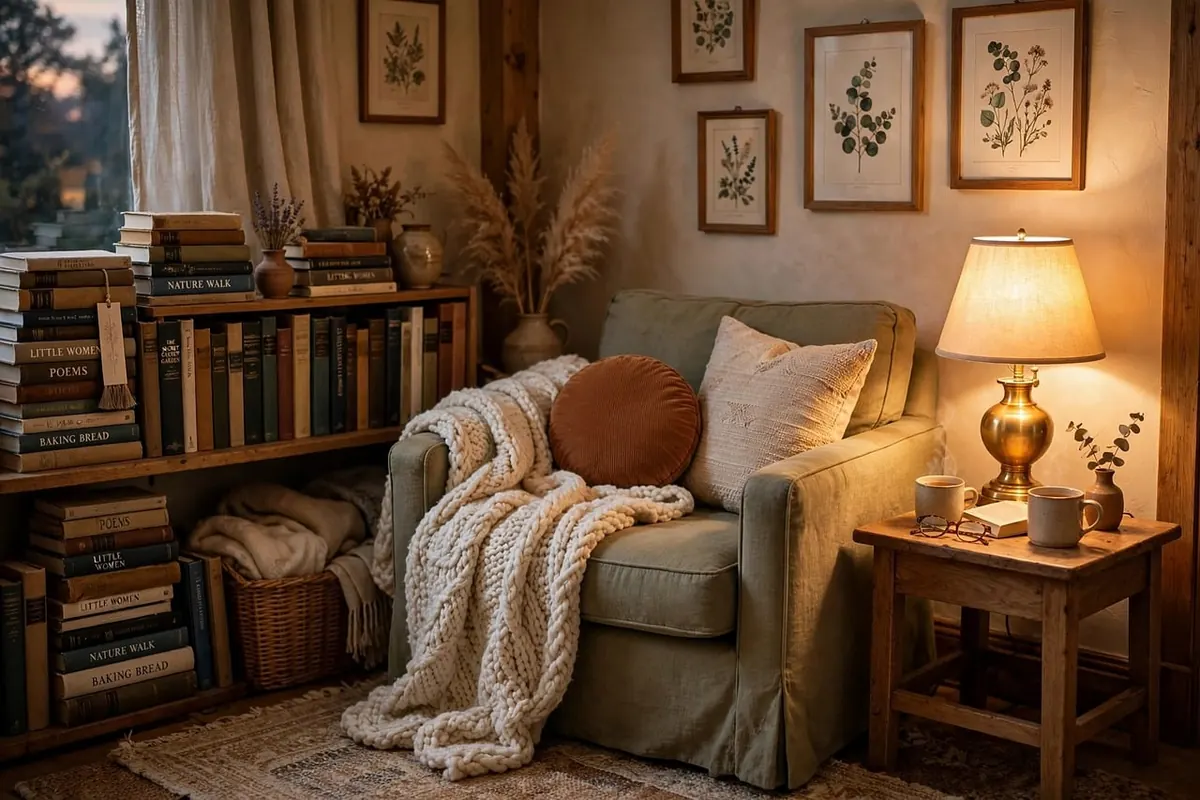
Small rooms can feel hard and echoey, especially if they have hard floors, bare windows, and plain walls. Textiles soften sound and make the corner feel enclosed without building anything. Start with a throw blanket in a colour that repeats something else in the room, then add one or two cushions. A small rug under the chair can define the nook without cutting the room into pieces, and a curtain or Roman blind can make a window feel less exposed.
Texture matters as much as colour. A chunky knit throw, a linen cushion, a wool rug, and a woven basket give the eye something to rest on. In a compact living room, choose two or three textures rather than ten. Too many patterns can make a small space feel cluttered, while too few can make it feel like a waiting room. If you already have a busy sofa, keep the reading corner quieter. If the sofa is plain, the corner can carry a little more pattern.
Keep it part of the living room
The trick mentioned at the start is to treat the nook as part of the room rather than a separate zone. That means repeating colours, materials, and shapes from the main seating area. If your sofa is grey, use a grey throw or a grey lamp base. If the room has brass handles, choose a brass reading light. If the coffee table is walnut, a small walnut side table will make the corner feel inevitable rather than added on.
Scale is equally important. A giant armchair in a small living room will look like a furniture showroom mistake, while a tiny delicate chair can look lost. Aim for a chair that is roughly the same visual weight as the sofa. You can also use a side table that doubles as a plant stand, a drinks table, or a place to charge your phone. This is how the corner earns its floor space on the evenings you would rather watch television.
Keep at least one sightline open. If the chair blocks the view from the doorway to the window, or from the sofa to the television, the room will feel smaller. Angle the chair slightly toward the room rather than pushing it flat into the corner. A diagonal placement often uses less visual space than a square one, and it makes the nook feel welcoming rather than punitive.
Small-space storage that doubles as reading kit
Reading corners attract clutter: books, glasses, cups, chargers, blankets, and half-finished crossword puzzles. A small side table with a lower shelf, a narrow basket, or a wall-mounted shelf can keep the essentials close without taking over the room. Use the rule of one: one book, one light, one drink, one throw. Everything else can live elsewhere and rotate in when you need it.
- Side table with a shelf: holds a lamp on top and a book or basket below.
- Wall shelf or picture ledge: keeps books and a small speaker off the floor.
- Woven basket: stores a throw and a cushion when the corner is not in use.
- Ottoman with storage: works as a footrest, extra seat, and hiding place.
- Clip-on cup holder: useful if you have no table space at all.
Make it comfortable for the senses
A cosy corner is not only visual. Temperature matters: a chair beside a window can be lovely in summer and freezing in winter, so add a throw or move the chair slightly away from the glass. Sound matters too. A small rug and a curtain will absorb some echo, and a pair of headphones or a tiny speaker can make the corner feel like a room within a room.
Scent is optional but powerful. A single candle, a reed diffuser, or a few drops of essential oil on a cotton pad can signal that this is a different kind of space. Keep it subtle. In a small living room, strong scents can quickly become overwhelming. The same goes for colour: choose one accent colour and repeat it in the throw, the lamp, and the book spines if you can.
A five-step setup you can do this weekend
- Clear the corner. Remove anything that does not belong there, including bags, drying racks, and exercise equipment.
- Test the chair. Sit in it for twenty minutes with a book. If you fidget, try a cushion, a footstool, or a different chair.
- Fix the light. Move a lamp until the page is bright and your eyes are not. Add a dimmer bulb if possible.
- Add one textile. A throw, a cushion, or a small rug is enough to start. You can layer more later.
- Use it for one week. If you never sit there, change the chair angle, the lamp height, or the location. A reading corner should be used, not admired.
Common mistakes to avoid
One common mistake is buying the chair before measuring the space. Another is choosing a beautiful chair that is uncomfortable for more than ten minutes. A third is placing the light in front of you, which creates glare, rather than beside or behind you. Finally, do not seal the corner off with a room divider or a tall screen unless you truly need privacy. In a small living room, a reading corner works best when it feels like a natural extension of the room, not a separate pod.
If you have almost no floor space, look up. A wall-mounted shelf, a swing-arm sconce, and a folding stool can create a reading spot that disappears when you need the room. If you have a window seat, use it. If you have a deep sill, add a cushion. If you have neither, a floor cushion beside a radiator and a rechargeable lamp can still give you the essential pleasure of a corner that belongs to reading.
Start small. The corner does not need to be perfect on the first day. It needs to be comfortable enough that you choose it once, then again, and then find that the smallest room in the house has quietly become the one you look forward to sitting in.
Photo: DianaZG / Pixabay